Come and join us across the globe
 Founded by Pr. Jacques Moret 
Sign In

The Youngest Challenge: Emergency Stenting for Pediatric Ischemic Stroke

Last update on May 6, 2026

This case details the rapid clinical decline of a pediatric patient presenting with fluctuating focal deficits, successfully managed through mechanical thrombectomy and rescue stenting despite a complex diagnostic workup for underlying arteriopathy.

Case presentation

Medical History & Background

  • Family: Strong thrombotic predisposition (Mother/Aunt: Factor VIII overproduction; Paternal Grandfather: Multiple TIAs).
  • Personal: Recurring headaches since age 6; otherwise healthy and active.

Timeline of the Event (Jan 23rd)

  • Late Afternoon: Developed back pain, migraine with ocular involvement, and abdominal pain during basketball practice.
  • 20:30 (Onset): Sudden loss of balance and collapse while at a party.
  • Initial Symptoms: Confusion, delayed responses, tremors, nausea/vomiting, and loss of fine motor skills.
  • 21:30 (ER Admission): Arrived stable but confused; toxicology screen was negative.
  • Clinical Decline: Developed expressive difficulties (anomic aphasia) and left-sided hypotonia.

Clinical Evolution (Jan 24th)

  • 04:00: Admitted to Pediatrics; Initial non-contrast CT was negative.
  • 12:00 (Neurological Consultation): Significant worsening with fluctuating symptoms.
  • Exam: Left hemiplegia and complete facial nerve palsy.
  • Severity: NIHSS: 12 | PedNIHSS: 13
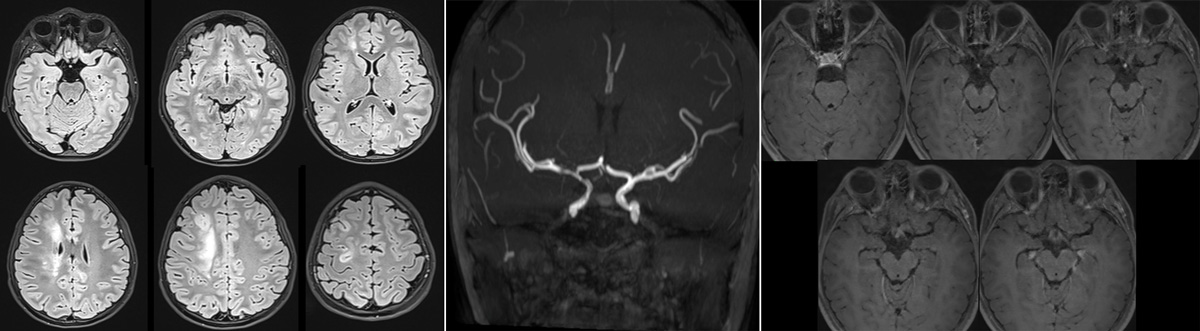
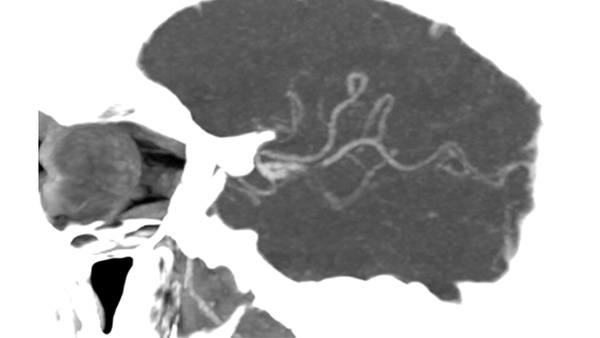
  • 16:40 (Advanced Imaging): Urgent workup including MRI (DWI/FLAIR), CECT, CTA, and Perfusion CT.

Baseline CT


MRI  15:00


Perfusion imaging is feasible in children, but:

  • Cutoffs for defining the ischemic core and penumbra are not yet standardized; however, some studies suggest that EVT (Endovascular Thrombectomy) can improve outcomes in patients with clinical-radiological mismatch and salvageable brain tissue
 

Femoral sheath 6F - Benchmark 105 cm - Vertebral 5F 120 cm


Sofia 5F – 1 ADAPT

Sofia 5F - Trevo Pro 21 - pReset 4x20mm - Embotrap III 5x22 mm


1,5 mg Nimodipine


Neurospeed 3 x 8 mm

pEGASUS 4,5 x 20 mm


Tirofiban Bolus: 21 ml - Maintenance: 229 ml at 7 ml/h for 12 h - Overlapped at 10 hours with Clopidogrel 75 mg

  • 24 hours later NIHSS: 12 --> 10 (minimal recovery of mobility in the lower limb)
  • 36-48 hours later: slight left hemiparesis
  • 6 days later: no deficits

6 days later MRI

  • PFO? Observed on post-thrombectomy echocardiogram; small, not hemodynamically significant. Subsequent bubble test was negative.
  • Coagulopathy? Family history significant for Factor VIII alteration on the maternal side with a positive family history of thrombosis. However, genetic testing, homocysteine levels, and Factor VIII assay were negative.
  • FCA-I (Inflammatory Focal Cerebral Arteriopathy)? Child vaccinated for varicella; no history of recent infections. Furthermore, although not performed immediately after the event, vessel wall imaging showed no signs of parietal inflammation.
  • FCA-D (Dissection-related Focal Cerebral Arteriopathy)? Although unclear—as it was initially reported, then denied, then reported again—the child allegedly complained of a headache at the party. Additionally, the child has a history of headaches since third grade, with a frequency of 10 days per month.
  • Vasculitis?
  • Early-stage Moya-Moya?

Back to clinical case contest

On the same subject
Come and join us across the globe
 Founded by Pr. Jacques Moret