An 82-year-old patient presented with a severe stroke (NIHSS 22) due to a left carotid T occlusion. Discover how a mechanical thrombectomy using a 0.088 large-bore aspiration catheter enabled a rapid and efficient recanalization, proving critical for the patient's clinical recovery.
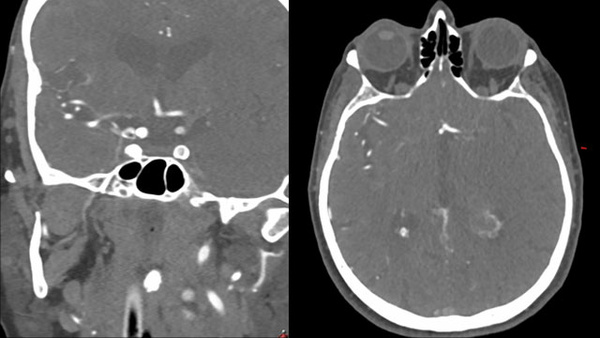
Baseline CT MCA hyperdensity
AngioCT - Internal carotid artery occlusion
| Medical imaging | CT, CTA |
| Treatment chosen | Mechanical thrombectomy using a distal large-bore aspiration technique with the SOFIATM Flow 88 catheter was selected due to the presence of a proximal large vessel occlusion (left carotid T occlusion) associated with a severe neurological deficit, and the absence of established infarction on baseline imaging. |
| Devices used |
|
| Description of the treatment |
Ultrasound-guided right femoral puncture was performed using a micropuncture kit. An 8F sheathless long femoral introducer was advanced over a 0.035″ guidewire into the descending aorta. After removal of the introducer dilator, the 0.088″ large-bore aspiration catheter (SOFIATM Flow 88), the diagnostic catheter, and the guidewire were advanced together and navigated up to the proximal internal carotid artery. At this level, the diagnostic catheter was withdrawn, aspiration was initiated using a pump, and the SOFIATM Flow 88 was advanced into the intracranial internal carotid artery. The aspiration catheter was then withdrawn under continuous aspiration, with simultaneous manual aspiration through the introducer using a 60-mL VacLok syringe, resulting in clot removal and vessel recanalization. |
Supported by Terumo Neuro
This case review is provided solely for educational and scientific purposes and does not replace the official Instructions for Use (IFU). Availability, indications, and regulatory approval of medical devices may vary by country or region; healthcare professionals should verify that the device is approved for use in their local jurisdiction. Healthcare professionals must always refer to the current, locally approved IFU before using any medical device. For complete IFUs of MicroVention products, please visit https://www.terumoneuro.com/. For third-party products, please consult the respective manufacturer’s website. MicroVention does not endorse or assume responsibility for third-party product information.