Endovascular without borders
On Day 2 in Singapore, endovascular crossed borders of every kind: technical, with a flow diverter deep in a 2 mm PICA; therapeutic, with new routes into hydrocephalus and epilepsy; and geographic, with a LINNC family that now reaches from Paris to Dhaka. All of it under the banner of the 2026 theme, pediatric AV malformations.
Innovation of the day
Two new frontiers for endovascular
Hydrocephalus: eShunt, CSF diversion without surgery
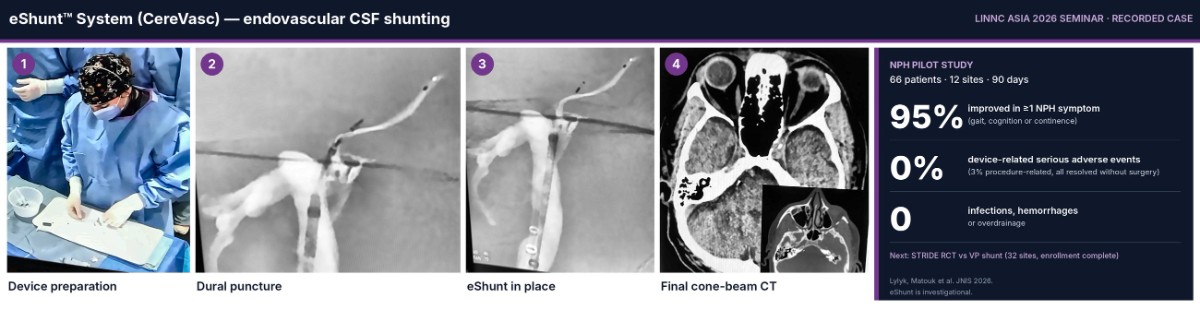
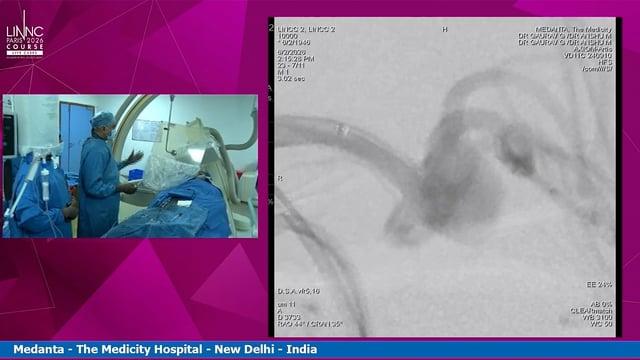
Presented by Prof. Vitor Mendes Pereira, the eShunt™* (CereVasc) is an endovascular CSF shunt: a small implant placed across the dura through a transvenous route, with no surgery. Early pilot data in NPH are striking, and the STRIDE randomized trial against VP shunting has completed enrollment. The flood of questions from the floor showed how closely the community is already watching.
From back-table preparation to final cone-beam CT: an endovascular route to CSF diversion.
“This will open a new window, and we will have dedicated meetings in the near future.”
— Prof. Vitor Mendes Pereira
“I would have loved to invent this device.”
— Prof. Laurent Spelle
Epilepsy: endovascular electrodes
Dr Yuji Matsumaru presented the development of novel endovascular electrodes for the diagnosis of epileptic focus and their broad applications. The EP01 system uses 0.010-inch electrodes, each with a detector at its tip. Through the jugular vein, up to six can be placed at once in the superior sagittal, cavernous and transverse sinuses, and they can stay in place for up to two weeks without anticoagulation. Recording brain activity from inside the venous system, without opening the skull, could change how we localize epileptic foci.
Endovascular Electrodes EP01.
Case of the day
A flow diverter inside a 2 mm PICA
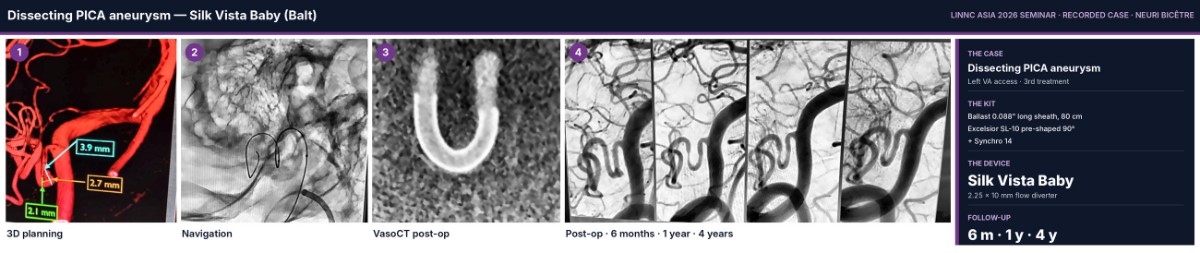
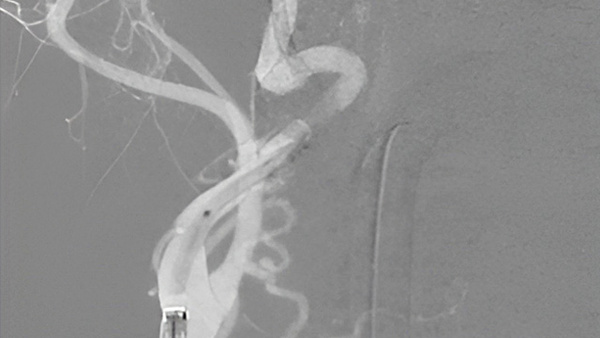
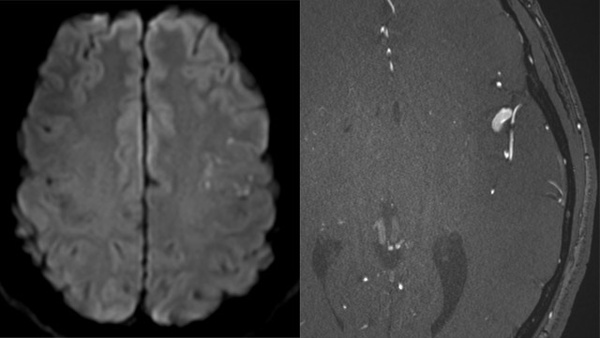
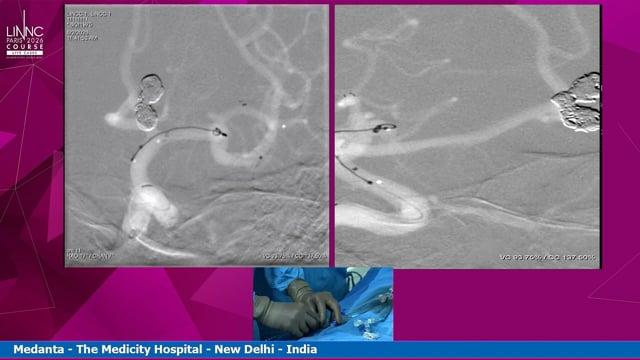
A dissecting PICA aneurysm from NEURI Bicêtre, treated through the left vertebral artery after previous endovascular attempts, in a small, tortuous branch measuring barely 2–3 mm. A Silk Vista Baby from the Balt company (2.25 × 10 mm) was navigated deep into the PICA and deployed through a low-profile microcatheter. The vessel was reconstructed, and the result held at 6-month, 1-year and 4-year follow-up.
From 3D planning to 4-year follow-up: flow diversion inside a 2 mm PICA.
“Isn’t it amazing to be able, today, to place a flow diverter in such a small and tortuous branch through a 17 microcatheter?”
— Prof. Laurent Spelle
The debate: direct reconstruction vs remote flow diversion
Direct reconstruction
Place the device across the lesion within the branch. This treats the dissection where it is and preserves the PICA, and today’s technology makes it feasible.
Remote flow diversion
Cover the PICA origin from the vertebral artery. Navigation is safer and simpler, and the aneurysm is treated through flow redirection, at the cost of less direct control over the lesion.
My take: I don’t see these as competing options. Having several strategies available is precisely what now allows us to address more and more complex situations, choosing the one that best fits each patient’s anatomy.
Focus
Intrasaccular devices: a technology taking over
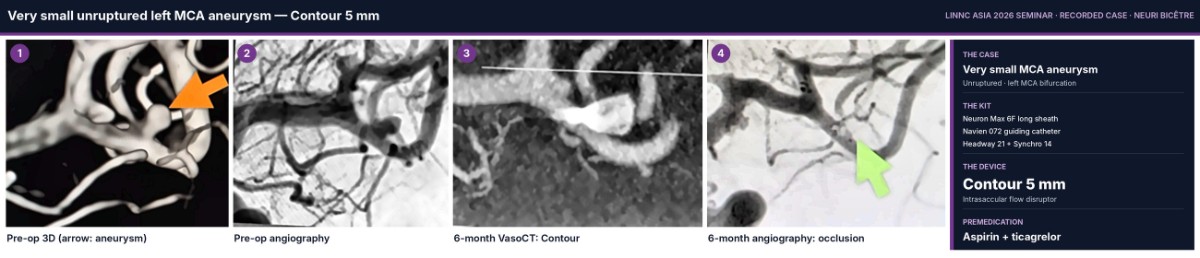
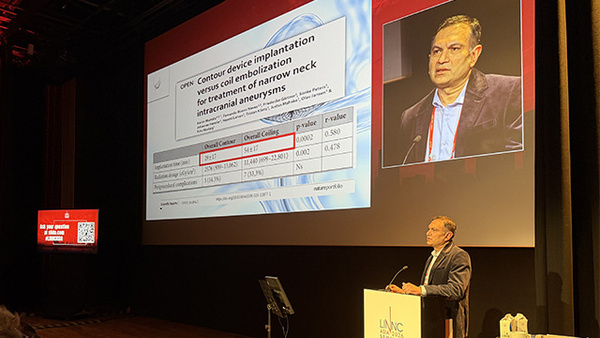
Today’s sessions featured case after case with WEB, Artisse and Contour, a reminder that small aneurysms can rupture too, and that these devices now give us a credible answer for them. One practical tip from the room: work with two views, an angulated projection off the AP and a lateral view showing the posteriorly pointing aneurysm, to judge sizing and deployment at the neck.
Safety.Little or no long-term antiplatelet therapy, no device in the parent artery, branches preserved.
Ease of use.Reproducible results, so high-volume centers and lower-volume centers with less experienced operators can achieve similar clinical outcomes.
Very small unruptured left MCA aneurysm treated with a 5 mm Contour: occluded at 6 months.
Special focus 2026
Pediatric arteriovenous malformations
Pediatric neurovascular disease is the theme of the 2026 LINNC Seminars, and Singapore gave it a full session with four voices:
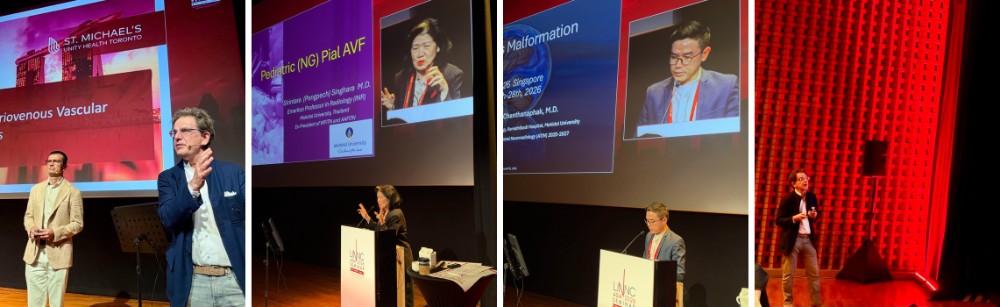
- Arteriovenous shunts in pediatric patients. A comprehensive review by Prof. Vitor Mendes Pereira (St. Michael’s Hospital, Toronto).
- Pediatric non-galenic pial AVFs. Prof. Sirintara (Pongpech) Singhara (Emeritus Professor, Mahidol University, Thailand; past President of the WFITN and the AAFITN).
- Dural sinus malformations. Asst. Prof. Ekachat Chanthanaphak (Head of INR, Ramathibodi Hospital, Mahidol University; President of ATIN).
- Vein of Galen aneurysmal malformation. Prof. Laurent Spelle commented on a recorded transarterial embolization performed by Dr Cristian Mihalea (NEURI Bicêtre): a choroidal-type VGAM, treated for the first time at one month of age.
Prof. Vitor Mendes Pereira, Prof. Sirintara (Pongpech) Singhara, Asst. Prof. Ekachat Chanthanaphak and Prof. Laurent Spelle on stage.
Behind the scenes
Sold out: the ePoster session
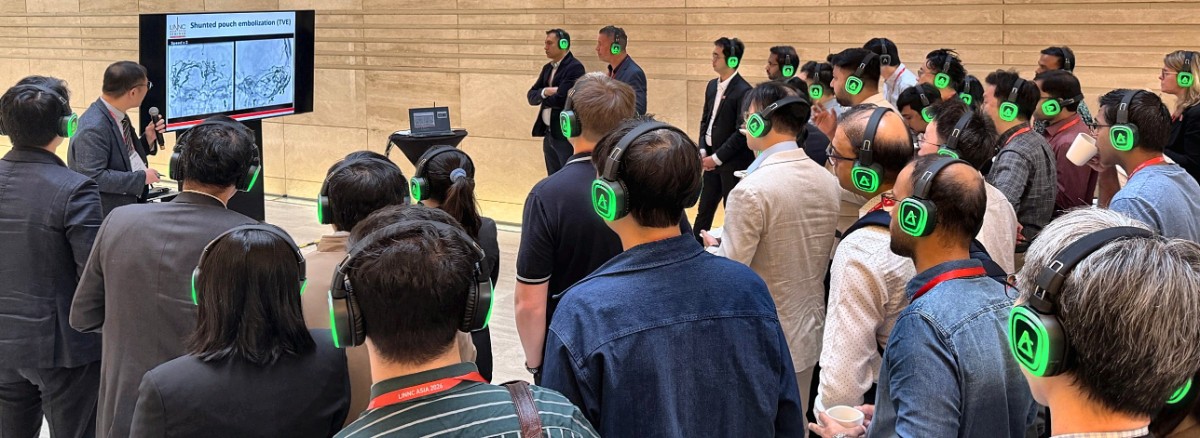
The ePoster session in the foyer, moderated by Hal Rice and Gaurav Goel, drew such a crowd that extra headsets had to be found in a hurry to accommodate everyone who wanted to listen in. A sold-out session for case-based ePosters says a lot about LINNC: attendees come for live, unfiltered exchange around real cases, and when the format works, the room simply fills up.
Silent-disco headsets, a packed foyer and a shunted pouch embolization on screen: interactive learning, LINNC style.
My favourite souvenir
LINNC is a family, and LINNC has an impact
Dr. Humayun Kabir Sarker, Secretary General of the Bangladesh Society of Neuro-Intervention, spent a few months with us at NEURI Bicêtre. We are honoured that he chose to train with our team, and proud of what he has achieved since returning to the National Institute of Neurosciences in Dhaka: he performed the first venous stenting procedures in Bangladesh and now has a special focus on idiopathic intracranial hypertension (IIH), a condition very close to my heart. Now part of the LINNC family, he honoured us by coming to LINNC Asia with a large part of his team. Seeing a fellowship turn into a new program on the other side of the world is exactly what LINNC is about.
From left: Dr. Shahida Bulbul, Dr. Aftab Rassel, Dr. Golam Sorowar, Prof. Jildaz Caroff, Dr. Humayun Kabir Sarker (Secretary General, Bangladesh Society of Neuro-Intervention), Dr. Anisul Hasan.
10 years of LINNC Asia
And the winners are…
Three awards were handed out on stage to close this anniversary edition. All three winners receive a fully covered trip to LINNC Paris 2027.
- Best Case Presentation Award: Dr. Yuh Yang Leong (Malaysia) “Intraosseous arteriovenous fistula of the jugular tubercle venous complex: problem solving with CBCTA and fusion angiography”
- Best Coffee Break Case Presentation Award: Dr. Dinesh Sharma (India) “Bypassing the orbit: direct trans-jugular cure of anterior condylar confluence DAVF”
- 10th Anniversary prize draw: Dr. Masahiro Nishihori
See you in Paris!
Dr. Yuh Yang Leong: Best Case Presentation Award.
Dr. Masahiro Nishihori: 10th Anniversary Award.
That’s a wrap
See you at LINNC Asia 2027 in Bangkok!
Two days in Singapore, ten years of LINNC Asia, and a field that keeps crossing new borders. Thank you to all the speakers, moderators and attendees who made this edition so lively. Next stop: Bangkok.
Reported by Prof. Jildaz Caroff for LINNC Online.
NEURI · Hôpital Bicêtre, Paris
LINNC Asia 2026 Seminar, Singapore
*eShunt and EP01 electrodes are investigational.