Industry symposium
Intrasaccular devices offer “one & done” treatment of wide-neck bifurcation aneurysms without long-term DAPT and without jailing branches. Gaurav Goel showed what that looks like in real life: the wins, the tricks and the sizing rules his team rewrote along the way.
Symposium presented by Dr. Gaurav Goel — Senior Director & Head, Neurointervention — Medanta, The Medicity, Gurgaon (India)
Introduction
As a convinced user of intrasaccular devices in my own practice, I particularly enjoyed this talk. Rather than another round of trial figures, Dr. Gaurav Goel shared a hands-on, practical experience built on his extensive work as an early adopter of the Contour device: how he selects his cases, how he sizes, when he adds coils, and what he learnt when things did not go to plan.
This report brings together the key messages and images from his presentation at the Stryker industry symposium of the LINNC Asia 2026 Seminar.
Prof. Jildaz Caroff
Interventional Neuroradiology, Hôpital Bicêtre (AP-HP), Paris
Concept
Fix the neck, not the sac
Contour is an endosaccular flow disruptor that sits at the neck and changes the hemodynamics there. The goal: occlusion as durable as clipping, no long-term DAPT, and bifurcation branches left free.
And it works by sealing the neck. In animal histology at 110 days, neointima grows across the mesh at the neck, healing the aneurysm from its entrance.
Advantages
One & done
- No / limited DAPT
- Branches preserved
- Immediate dome protection
- Shorter procedure
- No difficult manoeuvres
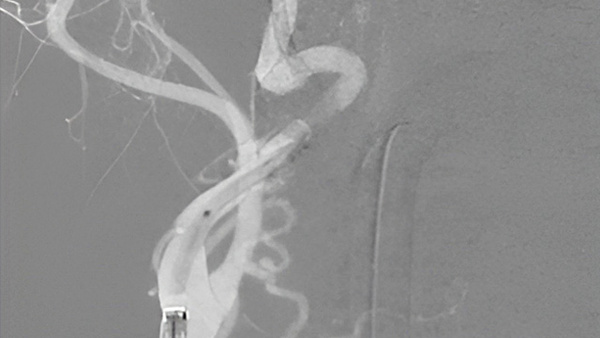
First lesson learnt: the proximal marker must sit below the level of the neck.
Indications
Nine questions, answered case by case
Wide-neck bifurcation, Bilobed, Small aneurysms?, Multiple aneurysms, Ruptured, Do we need coils?, …even in small ones?, When do we need more?, Ease of use.
Small aneurysm
3.2 mm M1 aneurysm, 5 mm Contour
Branch arising from the neck, 1.7 mm neck. Immediate complete obliteration, confirmed at 6 months.
Ease of use
No GA? No problem.
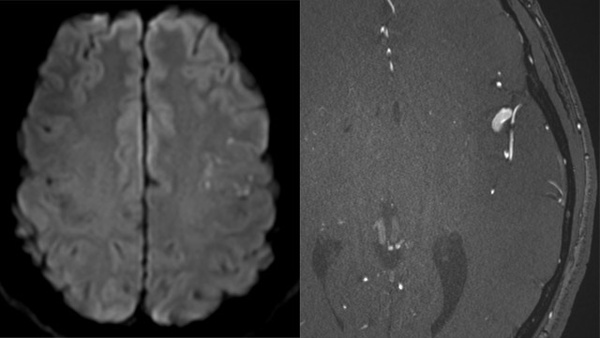
Pre-liver-transplant patient, recurrence 14 years after coiling, general anaesthesia contraindicated. ConCoil without crossing the aneurysm: all 3 branches preserved, complete obliteration.
Do we need coils?
Contour-assisted coiling
“In our practice, we recommend adjunctive coiling with 9, 11 and 14 mm Contours.”
— Dr. Gaurav Goel
ConCoil: Contour-assisted coiling
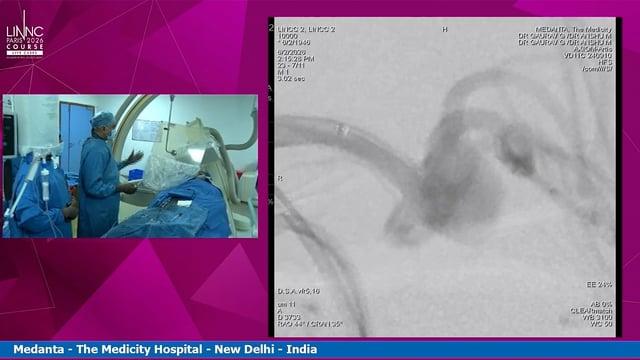
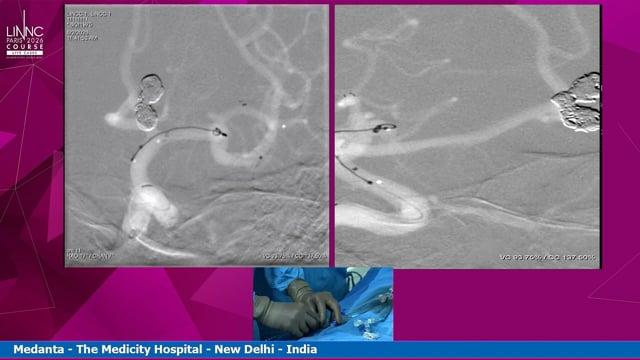
ConCoil: the coiling microcatheter is jailed, and the coil mass pushes the device against the aneurysm wall.
Issues
Size matters. So does the angle.
“If sized properly and placed properly, it works very well.”
— Dr. Gaurav Goel
Wine glass = right-sized · champagne = acceptable · martini = undersized, may migrate
The rule his team changed
“When two device sizes are suitable, we now favour the larger chart-listed Contour.”
| Aneurysm width
| Contour options
| Their choice
|
| 3 mm
|
5 or 7 mm
|
7 mm
|
| 5 mm
|
7 or 9 mm
|
9 mm
|
| 7 mm
|
9 or 11 mm
|
11 mm
|
| 8 mm
|
11 or 14 mm
|
14 mm
|
Medanta antiplatelet protocol
Ruptured
Aspirin 300 mg + prasugrel 50 mg or ticagrelor 180 mg, 2 h before the procedure.
Unruptured
Same loading the night before, then aspirin 75–150 mg + prasugrel 10 mg or ticagrelor 90 mg, 2 h before.
Withdraw one antiplatelet immediately after · stop all within 1 week – 1 month.
Synthesis
The case for Contour
For Goel, the case for Contour is about safety and simplicity: a single antiplatelet or none at all, a low thromboembolic risk, no in-stent stenosis and no jailed branches. That matters most in ruptured aneurysms, where avoiding long-term DAPT can decide the strategy. He is upfront about what it gives away: stents and flow diverters still have better-established long-term results.
The advantage for Contour holds with careful sizing, good case selection and enough experience with the device.
5 take-home messages
- Wide-neck bifurcation aneurysms with incorporated branches are the sweet spot.
- In ruptured cases, avoiding DAPT can be the decisive argument.
- When two sizes fit, take the larger one.
- Add coils with 9, 11 and 14 mm devices.
- Most failures trace back to sizing and case selection, not to the device.