Redefining workflow and patient communication with simulation technology
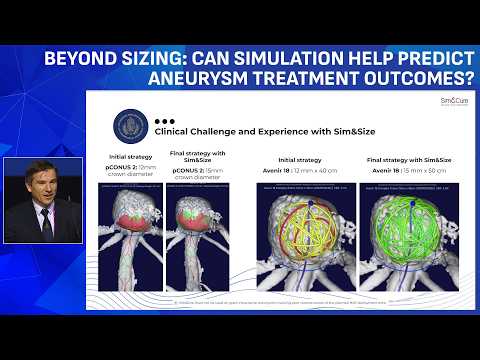
Integrating software solutions, such as Sim&Cure, into daily clinical practice marks a significant technological shift for neurovascular services. Daniel Mantilla highlighted that introducing patient-specific digital simulation natively optimizes the pre-operative workflow by significantly reducing surgical times. It enables the entire medical team to collaboratively share, review, and refine complex treatment plans before entering the angio suite.
Beyond internal technical planning, simulation technology serves as a powerful communication tool. Interventional radiologists can move beyond abstract drawings or complex angiograms to visually show patients the exact procedure planned for their brain vessels. This visual dialogue enhances patient comprehension, fosters informed consent, and builds strong clinical confidence ahead of complex surgeries.
Scaling global training: combining virtual and hands-on modalities
As education expands across Latin America, simulation technology has become a cornerstone of neurointerventional fellowships. For educational purposes, virtual platforms allow a single patient anatomy to be simulated ten or more times using different therapeutic approaches. This capability enables fellows to experience multiple surgical scenarios from a single case, accelerating their learning curve.
To maximize this educational framework, modern centers combine digital software with physical hardware:
- Virtual simulation: accelerates early-stage learning curves and allows safe, repeatable procedural trials.
- 3D-printed silicon models: offers highly accurate hands-on training using exact, patient-specific aneurysm shapes replicated via 3D printing.
Looking toward the future, the next evolutionary step for simulation technology lies in the integration of Artificial Intelligence. By aggregating data from thousands of simulated surgeries, future AI models could predict the most effective patient-specific treatments, factoring in not only geometric vessel parameters but also distinct clinical histories to anticipate long-term healing outcomes.