Patient situation
A 56-year-old woman presented with an incidental aneurysm of the right middle cerebral artery (MCA), near the origin of the anterior temporal artery. The aneurysm had a wide neck [Fig.1A], and the ipsilateral carotid artery was extremely tortuous [Fig 1B].
Treatment strategy
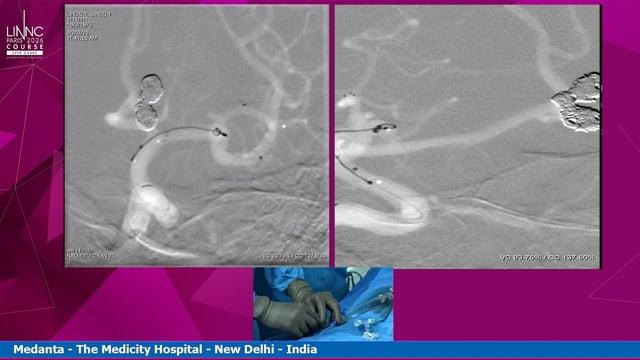
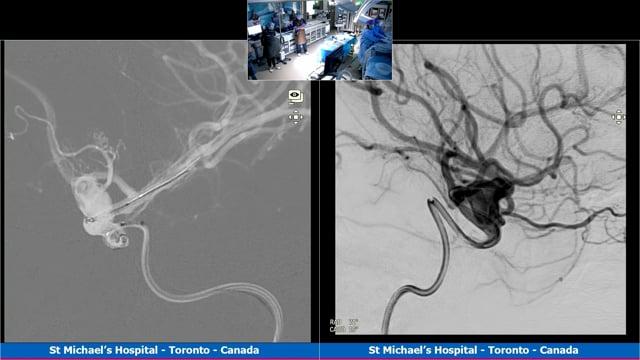
The aneurysm selection was challenging, and microcatheter control was difficult due to the carotid tortuosity. In Fig. 2A, the microcatheter tip is positioned well deep inside the aneurysm. In Fig. 2B, the aneurysm is directed posteriorly and is not aligned with the axis of the proximal middle cerebral artery (M1), which explains the need to use a steam-shaped ‘pigtail’ microcatheter to achieve stable access. Ultimately, the aneurysm was safely catheterized using this configuration [Fig. 2].
However, concerns remain regarding microcatheter stability (including potential premature kickback) during coil deployment.
Taking advantage of the Optima coil pusher capabilities, including smooth delivery of the coil without friction in tortuous anatomy and minimal microcatheter kickback, two supersoft helical Optima coils were deployed [Fig. 3].
Two additional coils were then deployed to complete the treatment with the assistance of a braided stent, resulting in complete aneurysm occlusion without any hemorrhagic or ischemic complication [Fig. 4].
Follow up
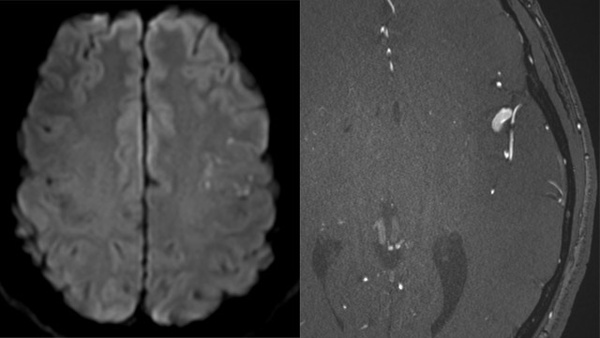
Control MR angiography at 18 months after treatment demonstrated stable occlusion of the treated aneurysm despite artefactual parent arterial stenosis at the stented MCA segment [Fig. 5].
Control MR angiography at 42 months after treatment demonstrated stable occlusion of the treated aneurysm despite artefactual parent arterial stenosis at the stented MCA segment (Fig. 6. A).
The source images revealed the patency of the stented segment (Fig. 6. B) and complete occlusion of the aneurysm well (Fig. 6. C, arrow).
Conclusion & discussion
This case involved several technical challenges including a wide-neck aneurysm, severe carotid tortuosity, and limited microcatheter stability.
These difficulties were successfully addressed using the Optima coil system.
In some challenging situations, we need a high-performance coil system.
The Optima coil system may be particularly beneficial in challenging situations such as distal aneurysms, tortuous vascular anatomy, and wide-neck lesions, where improved pushability and reduced microcatheter kickback are critical for achieving dense coil packing.
References
- SLUZEWSKI, M.; VAN ROOIJ, W. J.; SLOB, M. J.; BESCÓS, J. O.; SLUMP, C. H.; WIJNALDA, D. Relation between aneurysm volume, packing, and compaction in 145 cerebral aneurysms treated with coils.
Supported by Balt